
Smart Factories & IE: The Future of Garment Manufacturing in China
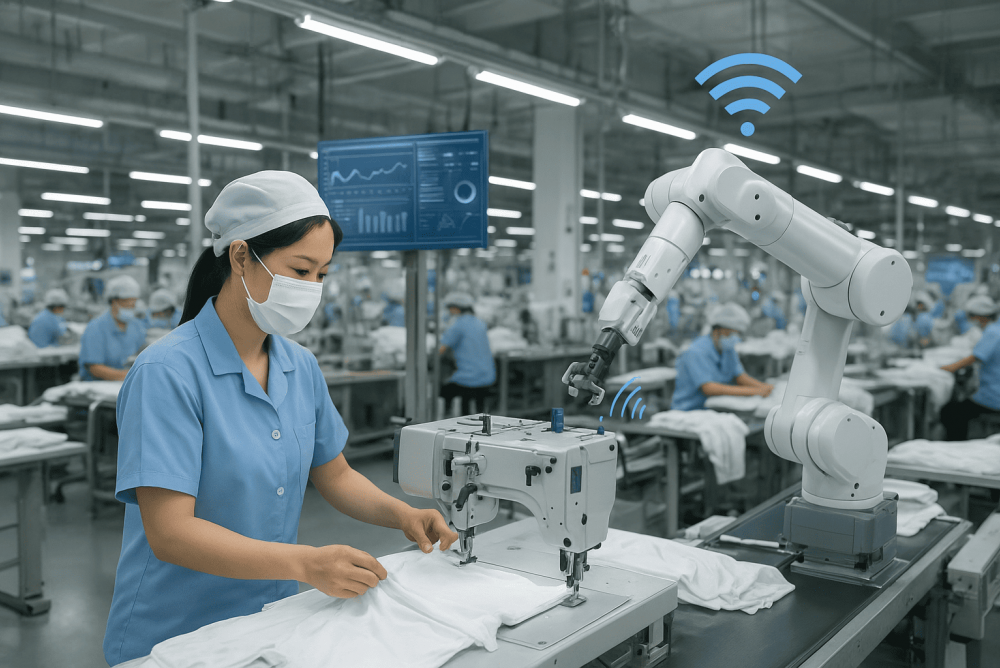
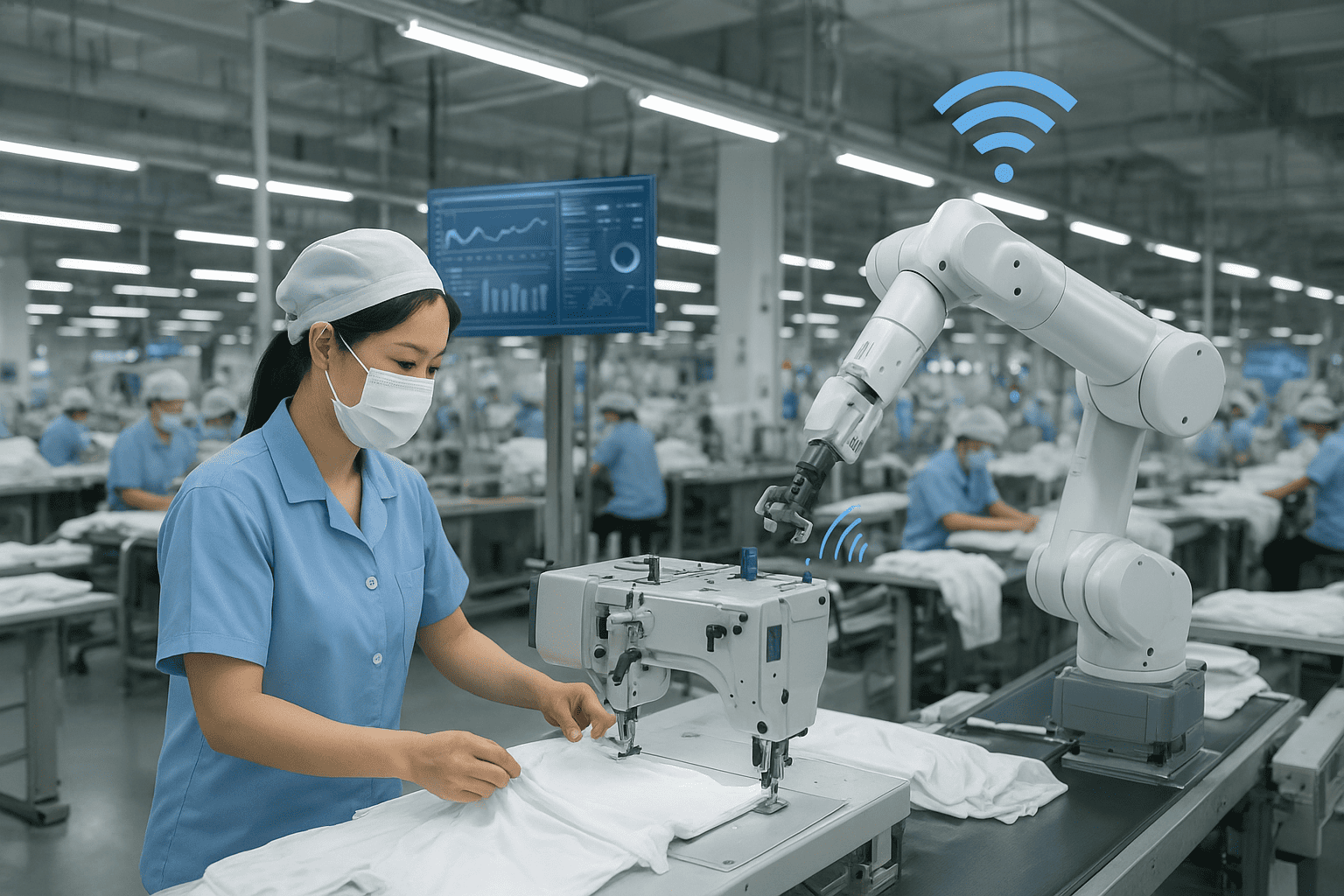
China’s garment manufacturing industry is undergoing a rapid transformation.
Once known for low-cost, labor-intensive production, it is now pivoting towards high-tech, data-driven, and efficiency-focused operations. This evolution is largely driven by the convergence of Industrial Engineering (IE) principles and smart factory technologies.
In 2024, China accounted for over 31% of the world’s apparel exports (WTO data). With increasing labor costs and intense competition from Southeast Asian countries, garment manufacturers in China are under pressure to deliver higher productivity, lower defect rates, and faster lead times without sacrificing quality.
Smart factories — equipped with Internet of Things (IoT) sensors, AI-powered analytics, and automation — are becoming the backbone of this shift. At the same time, Industrial Engineering offers the structured methodologies to streamline processes, optimize workstations, and eliminate waste. The combination creates a powerful force shaping the future of garment production.
The transformation isn’t just about replacing workers with machines. It’s about building a data-integrated ecosystem where production lines, workers, managers, and machines communicate in real time. This allows companies to:
Predict production delays before they happen.
Adjust output instantly to meet order changes.
Reduce fabric waste by up to 15% through precision cutting systems.
China’s government policies — such as the Made in China 2025 initiative — are accelerating adoption. Major garment hubs like Guangzhou, Shenzhen, and Ningbo are piloting factory automation projects combining Lean manufacturing with smart monitoring systems.
The global garment market is expected to grow to $2.3 trillion by 2030 (Statista), but competition will favor those who can produce smarter, faster, and cleaner. For China’s garment manufacturers, embracing Smart Factories + IE is not optional — it is the next survival strategy.
Understanding Industrial Engineering (IE) in the Garment Industry
Industrial Engineering (IE) is the backbone of efficiency in modern garment manufacturing. It is not just a set of techniques; it’s a systematic approach to designing, improving, and managing production systems for optimal output.
In the garment sector, IE applies structured methods to minimize waste, reduce cycle times, and enhance productivity while maintaining product quality. Unlike traditional production management, IE focuses on data-driven decision-making rather than relying solely on experience or intuition.
2.1 The Role of IE in Apparel Production
In a typical Chinese garment factory, hundreds of operators work on multiple lines, each producing a specific style. Without IE principles, bottlenecks occur, lead times increase, and defect rates climb.
IE addresses these challenges through:
Time and Motion Studies – Breaking down each operation into elemental tasks to identify inefficiencies.
Line Balancing – Allocating work evenly across operators to ensure continuous workflow.
Work Measurement – Establishing accurate production standards using Standard Minute Value (SMV) calculations.
Process Optimization – Rearranging operations to reduce handling, transport, and idle time.
For example, an IE audit in a Shenzhen factory revealed that re-sequencing operations on a T-shirt sewing line reduced production time by 18% without increasing labor hours.
2.2 Key IE Tools in Garment Manufacturing
Some of the most widely used IE tools in Chinese garment factories include:
GSD (General Sewing Data) – A software-based system for accurate SMV calculations.
Method Study – Detailed examination of how work is performed to identify better methods.
5S Workplace Organization – Sorting, setting in order, shining, standardizing, and sustaining.
Kaizen – Continuous small improvements driven by worker feedback.
Value Stream Mapping (VSM) – Visualizing the entire production flow to locate waste.
In China, large exporters such as Esquel Group and Shenzhou International integrate GSD and Kaizen into daily operations, resulting in 5–10% yearly productivity gains.
2.3 Measuring IE Effectiveness
IE performance is typically measured using key metrics such as:
Line Efficiency (%) = (Total SMV Produced ÷ Total SMV Available) × 100
Right First Time (RFT) – Percentage of garments that pass quality checks without rework.
Overall Equipment Effectiveness (OEE) – A measure of machine productivity factoring in availability, performance, and quality.
For instance, a Ningbo-based factory implementing IE-led workflow redesign saw its line efficiency jump from 65% to 82% within six months.
2.4 IE as the Foundation for Smart Factories
While IE has been a staple of the garment industry for decades, its role is expanding in the smart factory era. The principles of work measurement, waste elimination, and flow optimization remain the same — but now, real-time data from IoT devices allows IE teams to make faster and more accurate decisions.
A smart factory doesn’t replace IE; it amplifies it, providing continuous feedback loops and automated alerts that IE engineers can act upon immediately.
The Rise of Smart Factories in China’s Apparel Sector
The shift toward smart factories in China’s garment industry is not a passing trend. It’s a structural transformation fueled by economic pressures, global competition, and technological breakthroughs.
In the last decade, the global fashion market has been reshaped by fast fashion, e-commerce demands, and shorter product life cycles. Consumers now expect new designs within weeks, not months. For Chinese garment manufacturers, this has meant rethinking the entire production model.
3.1 Market Pressures Driving Smart Factory Adoption
Several key factors are pushing garment factories in China toward automation and digitalization:
Rising Labor Costs – Average manufacturing wages in China have increased by over 60% since 2013 (National Bureau of Statistics).
Competition from Southeast Asia – Countries like Vietnam, Bangladesh, and Cambodia offer lower labor costs, attracting global buyers.
Demand for Faster Turnarounds – Retailers like Zara and Shein require turnaround times as short as 7–14 days from design to store.
Strict Quality Requirements – Export markets demand consistent quality to meet brand and regulatory standards.
Smart factories address these challenges by reducing dependency on manual labor, improving speed, and minimizing errors.
3.2 Policy Support from the Chinese Government
Government initiatives are a major catalyst. The Made in China 2025 strategy includes textile and apparel manufacturing as a priority sector for digital transformation. Subsidies, tax incentives, and training programs encourage factories to invest in:
Industrial Internet platforms for real-time data sharing.
Advanced robotics for sewing, cutting, and packaging.
Energy-efficient systems to meet carbon reduction goals.
In cities like Suzhou and Guangzhou, pilot projects have demonstrated how integrating AI-powered production planning with automated quality control systems can raise line efficiency by 20–30%.
3.3 The Changing Role of Workers
Smart factories don’t mean a purely machine-driven environment. Instead, they shift the role of workers from repetitive manual tasks to monitoring, decision-making, and problem-solving.
Sewing operators become machine supervisors.
IE engineers work alongside data analysts.
Maintenance teams transition to predictive maintenance specialists using sensor data to prevent breakdowns.
This transition requires significant investment in workforce reskilling, which we will cover in Chapter 9.
3.4 Early Adopters Leading the Way
Several Chinese garment giants are already setting benchmarks:
Esquel Group has integrated RFID tracking and AI-based defect detection in its factories, achieving 98% on-time delivery rates.
Shenzhou International uses automated cutting systems linked directly to digital design files, reducing fabric waste by over 12%.
Youngor Group has deployed a central production control system that synchronizes all factory lines in real time.
These pioneers show that embracing smart factory concepts is not just a cost-saving measure — it is a competitive advantage in winning high-value export contracts.
Core Technologies Driving Smart Garment Factories
The backbone of a smart garment factory lies in its technological ecosystem. These technologies do not operate in isolation; they work together to create a connected, automated, and data-driven production environment.
4.1 Internet of Things (IoT) in Garment Manufacturing
IoT enables every machine, workstation, and even garment piece to communicate data in real time.
RFID Tags & QR Codes – Track each garment’s progress through the production line, ensuring no bottlenecks or misplaced items.
Machine Sensors – Monitor stitch accuracy, thread tension, and motor performance, triggering alerts before a defect or breakdown occurs.
Environmental Sensors – Maintain optimal humidity and temperature for fabric handling.
For example, a factory in Hangzhou using IoT-linked sewing machines reported a 14% drop in defects within six months.
4.2 Artificial Intelligence (AI) & Machine Learning
AI algorithms analyze production data to identify patterns, predict issues, and recommend solutions.
Predictive Maintenance – AI detects unusual vibration or heat patterns in machines, reducing unplanned downtime by up to 30%.
Automated Quality Control – Vision systems check for loose stitches, fabric flaws, or color inconsistencies at speeds impossible for human inspectors.
Production Planning Optimization – AI schedules lines based on current orders, fabric availability, and delivery deadlines.
Shenzhen-based Eagle Garment Systems uses AI to dynamically balance workloads across lines, improving throughput by 18%.
4.3 Computer-Aided Design (CAD) and Computer-Aided Manufacturing (CAM)
CAD Software – Digital pattern-making allows instant modifications without redoing physical samples.
CAM Cutting Machines – Automatically cut fabric according to CAD files with millimeter precision, reducing waste and improving cutting speed.
3D Virtual Sampling – Enables brands to approve designs without making physical prototypes, saving time and material.
This integration has shortened sample approval time for some factories from seven days to just 24 hours.
4.4 Robotics and Automation
Robotics in garment manufacturing is evolving fast, especially in areas that traditionally required skilled labor.
Automated Sewing Machines – Now capable of handling straight seams, pockets, and even basic garment assembly.
Material Handling Robots – Move fabric rolls, components, and finished goods between departments without human intervention.
Packaging Automation – Automatically folds, bags, and labels garments.
Though complex garment assembly still requires human dexterity, collaborative robots (“cobots”) are now assisting operators rather than replacing them entirely.
4.5 Digital Twin Technology
A digital twin is a virtual replica of a factory or production line that simulates operations.
Allows testing of new line setups without disrupting real production.
Predicts output changes based on different staffing levels or machine configurations.
Some Chinese apparel exporters now use digital twins to forecast how urgent orders will impact existing commitments, improving on-time delivery rates.
4.6 Cloud-Based Factory Management Systems
Cloud platforms integrate all data from IoT devices, ERP systems, and IE reports into one interface.
Real-time Dashboards – Accessible from anywhere, enabling managers to make quick decisions.
Supplier Integration – Links fabric mills and accessory suppliers to production schedules for smoother procurement.
Customer Visibility – Allows brands to track their orders through every stage of production.
Integration of IE Principles with Smart Manufacturing
The true power of smart factories in China’s garment industry lies not just in adopting advanced technologies, but in integrating these technologies with proven Industrial Engineering (IE) methodologies.
IE provides the framework for process optimization, while smart manufacturing tools supply real-time, actionable data. Together, they create a self-correcting production environment where inefficiencies are identified and addressed almost instantly.
5.1 From Static IE to Dynamic IE
Traditionally, IE teams conducted periodic time studies and line balancing exercises.
This process worked but lacked immediacy.
Data was collected manually, analyzed, and then implemented — often days or weeks later.
In a smart factory, IoT-enabled machines and AI analytics deliver continuous performance data. IE engineers no longer rely on periodic audits; they can monitor line efficiency, SMV performance, and defect rates in real time.
For example:
A Ningbo-based knitwear factory uses IoT-linked sewing machines that automatically log each operation’s cycle time. The IE team receives alerts when an operator’s efficiency drops below 85%, allowing quick intervention and training.
5.2 Real-Time Line Balancing
IE principles dictate that balanced production lines achieve the highest efficiency. Smart manufacturing enhances this through:
Live Operator Tracking – RFID badges monitor operator movement, ensuring minimal idle time.
Automated Workload Redistribution – AI systems can reassign tasks between operators in real time to avoid bottlenecks.
Predictive Scheduling – Production planning software anticipates delays based on current performance trends and shifts workloads accordingly.
This fusion allows some factories to maintain over 90% line efficiency even when styles change mid-shift.
5.3 AI-Powered Method Study
Method study — the heart of IE — traditionally involves observing operators and recording motions.
Smart factories use video analytics and AI motion recognition to:
Detect redundant hand movements.
Measure micro-delays in picking or placing garments.
Suggest alternative methods to reduce fatigue and improve speed.
Instead of days of manual observation, IE teams now get method improvement suggestions within minutes.
5.4 Data-Driven SMV Calculation
In conventional settings, SMV (Standard Minute Value) is determined through manual stopwatch timing or GSD software based on theoretical standards.
In a smart environment:
Machine sensors automatically log cycle times.
AI adjusts SMV values based on historical performance trends.
Seasonal factors (e.g., heavier fabrics in winter collections) are factored into SMV forecasts automatically.
This ensures production targets are realistic, fair, and achievable.
5.5 Closing the Loop: Continuous Improvement
The combination of IE and smart manufacturing fosters continuous improvement loops:
Data Collection – Sensors, cameras, and software record operational details.
Analysis – AI and IE teams identify bottlenecks, waste, or ergonomic issues.
Action – Adjustments are made instantly, not weeks later.
Verification – Data confirms whether the change improved performance.
This real-time PDCA (Plan-Do-Check-Act) cycle ensures that factories are always operating at peak efficiency.
5.6 Human-Centered Approach
Even with full automation support, IE’s human focus remains vital. IE engineers use smart data to:
Design workstations that reduce operator strain.
Set fair incentives based on accurate performance metrics.
Train workers on using technology effectively, ensuring that automation enhances rather than replaces human skill.
Benefits of Smart Factories for Garment Manufacturers
The integration of smart technologies with Industrial Engineering (IE) is delivering measurable, transformative benefits for garment manufacturers in China. These gains extend beyond simple productivity improvements — they influence profitability, sustainability, and market competitiveness.
6.1 Increased Productivity and Efficiency
Smart factories improve productivity by automating repetitive tasks and optimizing workflows.
Real-Time Monitoring – Ensures that line balancing adjustments happen instantly.
Automation in Cutting & Sewing – Reduces operation times by 20–30% for basic styles.
Predictive Scheduling – Minimizes downtime during style changes.
Example:
A Shenzhen sportswear factory increased daily output by 22% after integrating automated fabric cutting with IoT-enabled production tracking.
6.2 Reduced Operational Costs
Automation and real-time IE adjustments lead to cost savings in multiple areas:
Labor Efficiency – More output per worker, reducing the need for overtime.
Lower Rework Rates – AI-driven quality checks catch defects earlier, lowering reprocessing costs.
Energy Savings – Smart lighting and machine power optimization reduce electricity bills by up to 15%.
Even small percentage improvements compound across high-volume orders, resulting in millions in annual savings for large exporters.
6.3 Enhanced Product Quality
Consistency is critical for global apparel brands.
Vision Systems – Detect micro-defects invisible to the human eye.
Sensor Feedback Loops – Automatically adjust machine tension or speed for different fabrics.
Digital Pattern Cutting – Ensures every piece matches specifications exactly.
A Guangzhou-based uniform manufacturer reduced defect rates from 5.2% to 1.8% after implementing automated quality inspection cameras.
6.4 Faster Lead Times
In the age of fast fashion and on-demand manufacturing, lead time is a competitive weapon.
Instant Data Flow – Eliminates delays caused by manual reporting.
3D Virtual Sampling – Shortens design approval from weeks to days.
Dynamic Production Planning – Allows factories to switch between styles with minimal disruption.
For instance, Shein’s suppliers in China use rapid style-change systems that enable production runs as short as 200 pieces to be completed in under 10 days.
6.5 Improved Worker Safety and Ergonomics
Smart factories also enhance workplace safety:
Ergonomic Workstation Design – Based on IE studies and sensor feedback.
Automated Heavy Lifting – Robots handle fabric rolls and pallets.
Environmental Controls – Maintain air quality and temperature for worker comfort.
This leads to fewer injuries, reduced fatigue, and higher worker satisfaction — which, in turn, reduces turnover rates.
6.6 Sustainability Gains
Global brands increasingly demand eco-friendly production.
Precision Cutting – Reduces fabric waste by 10–15%.
Energy-Efficient Machines – Lower carbon footprint.
Digital Prototyping – Cuts sample waste and reduces water use in washing/finishing trials.
Factories adopting these measures often gain an advantage in securing contracts from eco-conscious brands like Patagonia and H&M’s Conscious line.
Challenges in Implementing Smart Factory Solutions in China
While the benefits of smart factories are clear, the path to adoption in China’s garment industry is not without obstacles. These challenges range from financial constraints to cultural shifts in workplace operations.
7.1 High Initial Investment Costs
Setting up a smart factory requires significant capital outlay:
Automation Equipment – CNC cutting machines, automated sewing systems, and robotic arms cost hundreds of thousands of dollars.
Software Platforms – Cloud-based ERP, IoT dashboards, and AI analytics tools carry high licensing fees.
Infrastructure Upgrades – Reliable high-speed internet, power backup systems, and climate control are essential.
For small and mid-sized factories, these costs can be prohibitive, especially when profit margins average just 5–8% in mass-market garment production.
7.2 Skills Gap in the Workforce
Smart factory operations demand a different skill set:
Machine Operators must understand sensor readings and troubleshooting basics.
IE Engineers must be proficient in data analysis and digital tools.
Technicians require knowledge of robotics maintenance and AI systems.
However, many existing workers in China’s garment hubs have decades of manual experience but limited exposure to digital technologies. Upskilling requires time, training, and cultural adaptation.
7.3 Integration with Legacy Systems
Many factories still run on outdated equipment and fragmented software systems.
Integrating new IoT devices with older sewing machines can be technically challenging.
Data incompatibility between different software vendors can cause delays in implementation.
Retrofitting solutions often work, but may limit the full potential of smart manufacturing.
7.4 Resistance to Change
Change management is a human challenge as much as a technical one:
Some managers fear automation will disrupt current workflows and affect delivery deadlines.
Workers may worry about job security, leading to passive resistance in adopting new tools.
Factory owners accustomed to manual oversight may find it hard to trust AI-driven decision-making.
Without clear communication about the long-term benefits, digital transformation projects can stall.
7.5 Cybersecurity Risks
As factories connect more equipment to the internet, cyber threats become a concern:
Hacking of production schedules or design files could disrupt operations.
Data leaks could expose sensitive brand information.
Ransomware attacks on factory systems have already been reported in Asia’s manufacturing sector.
Strong cybersecurity measures, including regular audits and staff awareness training, are essential.
7.6 Uneven Government Support
While large garment clusters like Guangzhou and Ningbo receive significant subsidies for digital upgrades, smaller towns and rural manufacturing areas may lack the same policy incentives, creating regional adoption gaps.
Case Studies of Leading Smart Garment Factories in China
Examining real-world examples is essential to understanding how smart factory concepts and Industrial Engineering (IE) integration work in practice. Below are three leading cases from China’s garment manufacturing sector that showcase innovation, measurable results, and scalability.
8.1 Esquel Group – Smart Cotton to Shirt Supply Chain
Location: Guilin, Guangdong, and multiple sites in China
Specialty: Premium cotton shirts for brands like Ralph Lauren, Tommy Hilfiger
Key Technologies Used:
Automated fabric cutting with Gerber and Lectra systems
IoT-enabled sewing machines
AI-powered quality inspection systems
Digital twin modeling for factory layouts
Results:
Labor productivity increased by 40% in key sewing lines.
Defect rates dropped from 3.5% to below 1%.
Fabric waste reduced by 12% through precision cutting algorithms.
IE Integration:
Esquel’s IE team uses real-time machine data to dynamically reassign operators based on workload. AI-generated SMVs ensure production targets are realistic and aligned with operator performance.
8.2 Shenzhou International Group – Sportswear Automation Leader
Location: Ningbo, Zhejiang
Specialty: High-volume sportswear for Nike, Adidas, Puma
Key Technologies Used:
Automated knitting and dyeing machines linked to MES (Manufacturing Execution Systems)
RFID-enabled work tracking
AI-based predictive maintenance
Results:
Order-to-delivery time reduced from 60 days to 45 days.
Machine downtime cut by 25% through predictive maintenance alerts.
Energy consumption reduced by 15% per garment.
IE Integration:
Shenzhou’s IE team leverages MES dashboards to track cycle times and WIP (Work in Progress) in real time, adjusting line balance daily based on demand fluctuations.
8.3 Youngor Group – Data-Driven Made-to-Measure Production
Location: Ningbo, Zhejiang
Specialty: Customized menswear and mass-market apparel
Key Technologies Used:
3D body scanning for precise customer measurements
Digital pattern-making software
AI-driven scheduling for personalized orders
Results:
Lead time for made-to-measure suits reduced from 15 days to 5 days.
Material usage efficiency improved by 18%.
Customer satisfaction scores rose by 22% due to better fit consistency.
IE Integration:
Youngor’s IE specialists optimize workstation layouts for custom orders, ensuring minimal motion waste even in highly varied production runs.




-500x500.jpg "Summer Boys' Leisure Print Set Colorful Sports Suit")
-500x500.jpg "Summer Boys' Tank Top Shorts Sports Set")
-500x500.jpg "Summer hollow-knit short-sleeved jumpsuit")
-500x500.jpg "Summer cute cartoon short sleeved climbing suit")
-500x500.jpg "Summer Square Neck Lace Fly Sleeves Baby Rompers")