
Card Setting in Carding Machines: Process, Types & Importance
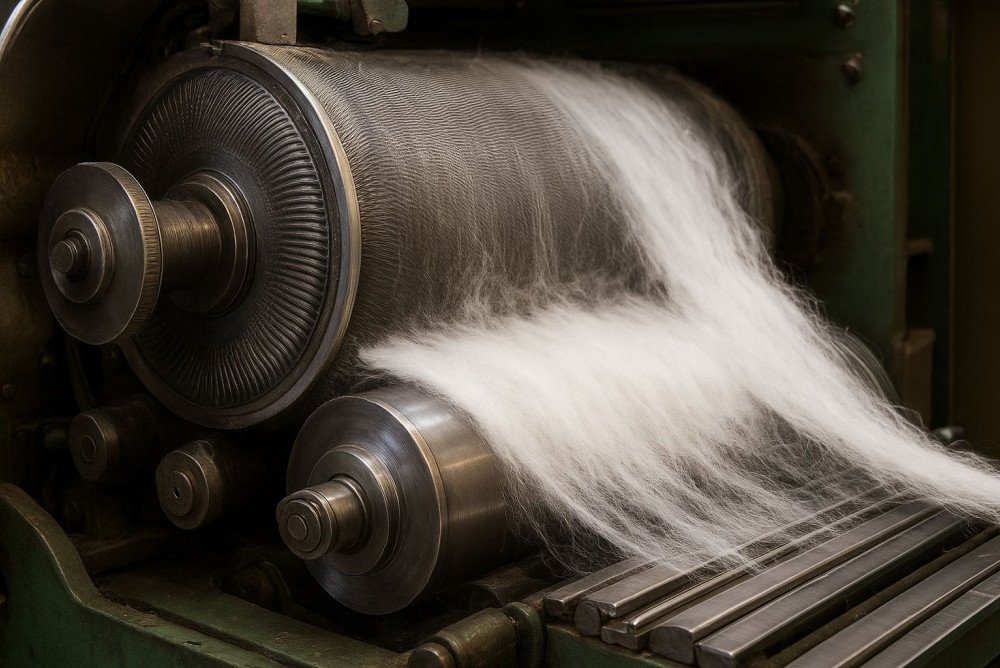

In the textile industry, the carding process is often referred to as the “heart of spinning.” It transforms tangled masses of cotton fibers into a smooth, uniform sliver ready for drawing and spinning. One of the most critical parameters that determine the quality and efficiency of this process is card setting — the precise adjustment of distances between various carding machine components.
Card setting defines how well fibers are individualized, cleaned, and aligned. Even a few microns’ difference in setting can influence fiber breakage, neps formation, and sliver uniformity. This precision-driven operation requires not just mechanical alignment but also technical judgment based on fiber type, machine model, and production objectives.
The carding machine, first developed during the Industrial Revolution, has evolved significantly. Modern high-speed carding machines, like the Trützschler TC series or Rieter C series, operate at over 1,200 revolutions per minute, handling fiber feeds of up to 200 kg/hour. Such high productivity can only be maintained if the card settings are optimized — balancing cleaning efficiency and fiber preservation.
Card setting, in essence, involves adjusting the clearances between the feed plate, licker-in, cylinder, flats, and doffer. These micro-adjustments ensure smooth fiber transfer across each zone, minimizing short fiber loss and ensuring better sliver consistency. For instance, the typical cylinder-to-flat setting in cotton carding ranges between 0.15 to 0.25 mm, while doffer-to-cylinder settings are even finer, around 0.10 to 0.20 mm.
Improper settings can result in serious issues — such as excessive neps, thick and thin places in yarn, and reduced production efficiency. On the other hand, well-calibrated settings improve fiber parallelization, enhance yarn quality, and extend machine life.
In recent years, automation has transformed card setting from a manual to a precision-controlled task. Advanced cards now use digital micrometer sensors and automatic gap control systems that adjust settings based on fiber length distribution and machine wear. Yet, human expertise remains irreplaceable. Experienced technicians rely on both measurement and intuition developed through years of handling different fibers.
Understanding Card Setting in the Carding Process
The carding machine plays a vital role in spinning preparation. Its core function is to open, clean, and align fibers into a uniform sliver. The efficiency of this process depends heavily on how accurately the card settings are established. To understand this, it’s essential first to know the main components and their interactions during the carding operation.
2.1 Key Components of a Carding Machine
Feed System – This includes the feed roller and feed plate, which guide the fiber batt into the licker-in.
Licker-in – Opens the fiber tuft into smaller clusters and begins the cleaning process by removing impurities.
Cylinder – The heart of the carding machine, covered with fine wire clothing, which combs and straightens fibers.
Flats (Revolving Flats) – Work in conjunction with the cylinder to enhance cleaning and fiber alignment.
Doffer – Transfers the carded web from the cylinder to form a sliver.
Coiler and Can – The final stage where the uniform sliver is collected for the next process.
2.2 What Is Card Setting?
Card setting refers to the precise distance (clearance) between these key machine elements. These clearances are typically measured in hundredths of a millimeter, as they directly affect how fibers are transferred, cleaned, and individualized.
For example:
Feed plate to licker-in setting: 0.45–0.70 mm
Licker-in to cylinder setting: 0.25–0.35 mm
Cylinder to flats setting: 0.15–0.25 mm
Cylinder to doffer setting: 0.10–0.20 mm
The exact setting varies depending on the fiber type, staple length, and machine speed. For fine cotton, tighter settings are used to improve cleaning and fiber control. For synthetic fibers, wider settings prevent fiber damage and static generation.
2.3 The Principle Behind Card Setting
The principle of card setting is based on controlled fiber transfer. Fibers should pass smoothly from one surface to another — for instance, from the licker-in to the cylinder, and then from the cylinder to the doffer.
If the clearance is too wide, fibers may fail to transfer, leading to neps and sliver irregularities. If it’s too narrow, excessive friction can break fibers and cause heat buildup.
Card setting ensures the right balance between:
Fiber cleaning (removal of dust, seed coat, and short fibers)
Fiber retention (avoiding waste and maintaining staple length)
Fiber alignment (achieving even sliver formation)
Modern machines employ gauge blocks, feeler gauges, or optical sensors to achieve micron-level accuracy. This precision prevents costly material loss and helps maintain consistent yarn quality across batches.
2.4 Effect of Card Setting on Fiber Behavior
The relationship between fibers and metallic wire surfaces is delicate. When the card setting is optimal, fibers are gently combed and laid parallel without entanglement.
However:
Too wide a setting leads to poor cleaning, higher nep formation, and sliver irregularity.
Too narrow a setting causes fiber damage, metallic wear, and excessive heat in the carding zone.
For example, research from the Textile Research Journal found that a 0.05 mm change in cylinder-to-flat setting could increase nep count by up to 15% in medium-staple cotton. Such findings highlight why precision card setting is not just mechanical fine-tuning but a science of fiber behavior.
2.5 Machine Condition and Environmental Factors
Besides geometry, the condition of the machine and ambient environment also influence card settings.
Worn-out wire clothing may require slight clearance adjustments.
Humidity and temperature affect static and fiber cohesion.
Dust accumulation alters fiber movement and setting consistency.
That’s why carding machines are regularly cleaned, and the working room is kept at around 65% relative humidity and 25°C temperature to ensure optimal fiber control.
Card setting, therefore, acts as the bridge between machine mechanics and fiber science. It transforms a mechanical operation into an art of precision — where fractions of a millimeter decide the difference between a good yarn and a defective one.
Types of Card Settings and Their Functions
Card settings are not uniform across the machine. Each component clearance plays a distinct role in fiber processing. Understanding these types is crucial for technicians, as each setting directly impacts sliver quality, production efficiency, and fiber preservation.
3.1 Feed Plate and Licker-in Setting
The feed plate-to-licker-in clearance controls how fibers enter the carding zone.
Wide setting: Suitable for coarse or long-staple fibers; prevents jamming.
Narrow setting: Used for fine cotton or short-staple fibers; improves cleaning efficiency.
Proper adjustment ensures the fiber tufts are evenly fed, reducing sliver irregularities and minimizing fiber breakage. Technicians often check this setting using feeler gauges or digital sensors, adjusting within 0.45–0.70 mm depending on fiber type.
3.2 Cylinder to Flats Setting
The cylinder-to-flats clearance is perhaps the most critical in carding. Flats are the stationary or revolving brushes that work with the cylinder to remove impurities and straighten fibers.
Tighter setting: Enhances fiber parallelization and cleaning efficiency.
Looser setting: Reduces fiber damage but may leave more neps and impurities.
For cotton carding, this setting usually ranges between 0.15–0.25 mm. Precise adjustment ensures uniform fiber transfer, allowing the cylinder to comb fibers without cutting or tearing them.
3.3 Cylinder to Doffer Setting
The doffer collects fibers from the cylinder and forms a web that becomes the sliver. Its clearance from the cylinder is extremely fine — typically 0.10–0.20 mm.
Too close: Fibers may get trapped, causing machine wear or fiber damage.
Too wide: Fiber transfer is incomplete, leading to sliver thin places and higher waste.
Accurate doffer settings are essential for maintaining consistent sliver weight and smoothness. Advanced machines now feature automatic doffer gap control, which adjusts in real-time based on fiber load and machine speed.
3.4 Licker-in to Cylinder Setting
This setting is crucial for fiber opening and initial cleaning.
Wide gap: Reduces fiber stress, suitable for coarse fibers.
Narrow gap: Improves cleaning but may shorten fibers if not monitored.
For most cotton types, the licker-in-to-cylinder clearance ranges from 0.25–0.35 mm, depending on fiber length and cleanliness requirements. Proper calibration minimizes short fiber loss and maintains sliver consistency.
3.5 Specialized Settings: Automatic vs Manual
Modern carding machines incorporate automatic settings for precision and consistency. These systems:
Use sensors and feedback loops to maintain optimal clearances.
Adjust for fiber length, staple distribution, and machine wear in real-time.
Reduce dependency on manual measurement, saving time and improving uniformity.
Manual settings still dominate in smaller mills or specialized fibers, where experienced technicians rely on feel and visual inspection. Both approaches aim to maintain a balance between fiber quality, productivity, and machine longevity.
3.6 Key Takeaways on Types of Card Settings
Every carding component has a specific role, and each clearance affects fiber behavior differently.
Precision in each setting reduces neps, sliver irregularities, and fiber loss.
Machine automation improves consistency, but human expertise remains crucial.
Settings must be adjusted based on fiber type, staple length, and production targets.
Understanding these types helps operators make informed decisions. It ensures that carding machines function efficiently, producing high-quality sliver while minimizing fiber waste.
Step-by-Step Process of Card Setting
Card setting is both a science and an art, requiring precise measurement and practical experience. Following a systematic process ensures fibers are handled gently, slivers are uniform, and machine efficiency is maximized.
4.1 Preparation Before Setting
Before making adjustments, technicians must:
Clean the machine thoroughly – Remove dust, fibers, and neps from the cylinder, flats, and doffer.
Inspect wire clothing – Check for worn or bent wires; replace if needed.
Ensure proper machine lubrication – Friction can affect clearance measurements and fiber behavior.
Verify environmental conditions – Maintain humidity at around 65% and temperature at 25°C for cotton processing.
Proper preparation prevents inaccurate settings and reduces fiber damage during carding.
4.2 Measuring Clearances
Accurate measurement is key. The commonly used tools include:
Feeler gauges – For measuring cylinder-to-flat and cylinder-to-doffer gaps.
Micrometer calipers – For licker-in, feed plate, and cylinder distances.
Optical or laser sensors – Used in modern automated cards for real-time monitoring.
Measurements should be repeated at multiple points across the cylinder and flats to account for wear or uneven surfaces. Consistency ensures uniform fiber transfer and high-quality sliver formation.
4.3 Adjusting Key Settings
Feed Plate to Licker-in: Adjust the gap to ensure fibers enter smoothly without clumping.
Licker-in to Cylinder: Fine-tune for optimal fiber opening and impurity removal.
Cylinder to Flats: Align cylinder and flats for precise fiber combing and nep reduction.
Cylinder to Doffer: Set for smooth fiber transfer, avoiding sliver breaks or machine wear.
After adjustment, perform a trial run at low speed. Observe fiber flow, nep formation, and sliver uniformity. Fine-tune as necessary until the process stabilizes.
4.4 Monitoring and Maintenance
Even with correct settings, ongoing monitoring is essential:
Sliver checks – Measure sliver weight consistency and fiber orientation.
Visual inspection – Look for neps, thick or thin places, and fiber damage.
Routine recalibration – Regular checks maintain optimal settings as wires wear over time.
Preventive maintenance not only prolongs machine life but also ensures consistent yarn quality.
4.5 Common Mistakes to Avoid
Ignoring fiber type variations – Short-staple and long-staple fibers need different settings.
Neglecting machine wear – Uneven wires or flats can mislead measurement.
Skipping trial runs – Immediate full-speed operation can damage fibers and produce irregular slivers.
Over-tightening settings – Can increase fiber breakage and machine friction.
Following a systematic, careful approach ensures that carding machines perform at their best, producing high-quality sliver consistently.
Importance of Proper Card Setting in Yarn Quality
Card setting is not just a technical adjustment—it directly impacts yarn quality, production efficiency, and cost-effectiveness. Properly set cards ensure fibers are aligned, cleaned, and handled gently, producing uniform slivers that form strong, consistent yarn.
5.1 Effect on Sliver Uniformity
Uniform card settings create slivers with consistent weight and thickness. Uneven clearances can cause:
Thick and thin places in sliver
Fiber clumping or neps
Irregular yarn count during spinning
For example, mills processing medium-staple cotton have reported that precise cylinder-to-flat and cylinder-to-doffer adjustments reduce sliver CV% by up to 20%, improving yarn evenness and reducing downstream wastage.
5.2 Influence on Yarn Strength and Elongation
Fiber alignment during carding is critical for yarn tensile properties. Proper card settings:
Parallelize fibers, reducing weak points
Minimize short fiber loss, which strengthens yarn
Improve fiber cohesion, enhancing elongation properties
Research shows that incorrect card settings can reduce yarn strength by 10–15%, especially in fine counts where fiber misalignment has a larger impact.
5.3 Reduction of Neps and Impurities
Neps—small fiber entanglements—are a common defect in carded slivers. Their presence can:
Increase yarn irregularities
Affect fabric smoothness and appearance
Lead to higher breakage during weaving
Optimal cylinder-to-flat and licker-in settings improve cleaning efficiency, reducing neps by up to 30%, depending on fiber type and staple length.
5.4 Impact on Production Efficiency
Well-set cards reduce fiber waste and machine downtime. Benefits include:
Fewer stoppages due to fiber jams or sliver breakage
Reduced need for manual corrections in downstream processes
Higher machine throughput and consistent quality output
For instance, a textile mill in India reported a 10% increase in daily sliver output after systematic card setting optimization.
5.5 Economic Significance
Card settings affect not only fiber quality but also production costs. Properly set machines:
Reduce fiber loss
Minimize energy consumption by avoiding friction and jams
Decrease labor costs due to fewer corrections
Even minor improvements in carding efficiency can translate into thousands of dollars saved per month in medium-sized mills, underlining the financial importance of correct card settings.
Key Takeaways
Proper card setting improves sliver uniformity, yarn strength, and elongation.
Reduces neps, impurities, and short fiber loss, enhancing final product quality.
Increases machine efficiency, reducing downtime and operational costs.
Directly contributes to the economic performance of textile operations.
In summary, card setting is more than a technical adjustment—it is a cornerstone of high-quality textile production. Every micron of precision counts, affecting fiber behavior, yarn performance, and production profitability.
Conclusion
Card setting in a carding machine is a critical factor in textile manufacturing. It determines how fibers are opened, cleaned, aligned, and transferred, directly affecting sliver uniformity, yarn strength, and production efficiency.
By understanding the types of card settings, their functions, and the step-by-step adjustment process, textile professionals can optimize machine performance. Whether through manual expertise or modern automated systems, precision in card setting is essential for achieving consistent, high-quality yarn.
Investing time in proper card setting not only improves product quality but also reduces waste, enhances efficiency, and increases profitability. For mills aiming to maintain a competitive edge, mastering the science of card setting is an indispensable skill.



-500x500.jpg "Summer Boys' Leisure Print Set Colorful Sports Suit")
-500x500.jpg "Summer Boys' Tank Top Shorts Sports Set")
-500x500.jpg "Summer hollow-knit short-sleeved jumpsuit")
-500x500.jpg "Summer cute cartoon short sleeved climbing suit")
-500x500.jpg "Summer Square Neck Lace Fly Sleeves Baby Rompers")